
Avocet chicks hatch at Slimbridge Wetland Centre
Avocet chicks hatch at Slimbridge Wetland Centre

A type of wading bird that was driven to extinction in Britain at one point has hatched in Gloucestershire.
Two avocet chicks have been born to a breeding pair at Slimbridge Wetland Centre, with the hatching of a third egg possible.
A Slimbridge spokeswoman said she thought it was the first time the birds had bred in Gloucestershire.
Staff have built an electric fence around the nest to protect it from predators.
‘Very vulnerable’
The distinctive black-and-white birds became extinct in Britain in the 19th Century due to habitat destruction and people collecting their skin and eggs.
The species was reintroduced to the UK in 1940 and the centre says numbers have now slowly recovered.
Dave Paynter, head of reserve at Slimbridge, said staff had been monitoring the nest for a long time.
“The next few days and weeks will be critical as they are very vulnerable before they grow a bit bigger,” he said.
“We will be keeping our fingers crossed for them and following their progress.”
http://www.bbc.co.uk/news/uk-england-gloucestershire-18095679
Finches’ personalities ‘shown by head colour’
http://www.bbc.co.uk/nature/18297721
Finches’ personalities ‘shown by head colour’ (BBC Nature 6June12)
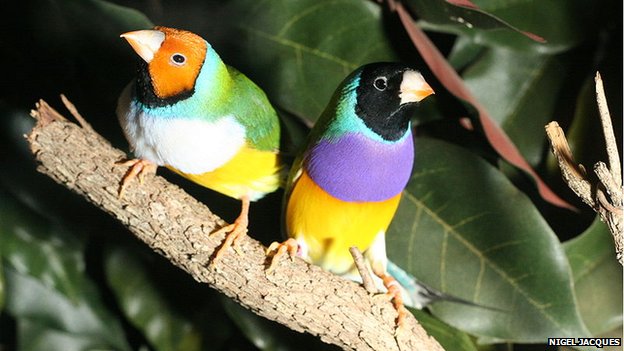
Gouldian finches have different personalities depending on the colour of their heads, researchers have found.
Scientists from Liverpool John Moores University and The Royal Veterinary College investigated the “highly sociable” Australian birds.
The team set the finches a series of behavioural tests to understand the purpose of their bright appearance.
They found that red-headed finches were more aggressive, while black-headed birds were bolder and took more risks.
Chinese farmer walks 5,000 ducks to a nearby pond – this man knows his ducks!
Chinese farmer walks 5,000 ducks to a nearby pond (BBC News Asia 25June12)
Traffic in the Chinese coastal city of Taizhou is brought to a standstill when 70-year-old Hong Minshun takes his 5,000 ducks for a walk.
Hong says that regular exercise to reach a nearby feeding pond is necessary to keep his ducks fit and healthy.
Drivers and passers by are amazed by the discipline of the ducks.
Doris set to have a quack at national poultry glory – Canberra Times (well spotted Tobsta)
Doris set to have a quack at national poultry glory
John Thistleton
 Margaret Day washes one of her Indian Runner Ducks, Doris, ahead of the Royal Canberra National Poultry Show. rt120607Ducks-3471.jpg Photo: Rohan Thomson
Washing Doris on her sunny front lawn yesterday morning, Margaret Day begged her champion Indian runner duck not to eat the grass.
”If she eats the grass and does a poo it’ll be green and stain her feathers.”
Doris will strut her radiant stuff at the record-breaking Royal Canberra National Poultry Show this weekend where more than 5250 chooks, guinea fowl, turkeys, geese and bantams will pack into the poultry pavilion at Exhibition Park.
Organisers bill the event as the biggest in the southern hemisphere. Numbers are so high they’ve knocked back more than 1000 entries from around Australia.
A drop of ”Bluo”, which brightens whites and colours, a splash of dog shampoo in the lukewarm bath and moisturiser on her egg yoke-yellow feet and beak have turned Doris into film star material.
Ms Day, of Carwoola, near Queanbeyan, bought Indian runner ducklings for pets, fell in love with them, joined a poultry club and five years later has 25 ducks.
Friendlier but messier than chooks, the ducks need daily watering to clean their eyes.
”They get a beak full and slop it over themselves and groom themselves, ” Ms Day said.
When the Canberra-Queanbeyan Poultry Club recently offered 250 birds for sale, demand out-stripped supply. Ms Day said backyard chooks returned to favour because of their promotion on lifestyle shows.
Don’t tell Doris, but poultry has taken over the dinner table from red meat and three veg, according to analysts at IBISWorld. This year, fresh poultry makes up 17.2 per cent of the meat, fish and poultry retailing sector, contributing $1.96 billion of its revenue. This compares with 16.3 per cent for the fresh beef and veal industry, which is worth $1.86 billion.
Feathers will be preened, not plucked, at the Royal National this weekend, where 58 judges from all over Australia will join international guest judges Graham Hicks from Britain and Ian Selby from New Zealand. Doris will be among eight ducks from the Day family, along with Dora, Daphne, Dolly and champion drake Dirty Beak and his son, Dirty Beak Junior.
Ms Day said she was lucky to get ducks from an excellent breeder with good bloodlines.
”When they are startled they will stand with a very straight back. They need to be able to stand when the judge comes along and rattles on the cage. They need to have a bottle-shaped body – if you image a wine bottle that sort of narrow neck tapering down to a round body shape.”
Be rest assured – Doris has still got it.
Diamond Jubilee: Queen adopts Slimbridge Bewick’s swan
http://www.bbc.co.uk/news/uk-england-gloucestershire-18268186
Diamond Jubilee: Queen adopts Slimbridge Bewick’s swan
 Diamond Two has visited Slimbridge every year since 2008
The Queen has accepted the offer of a Bewick’s swan to commemorate her Diamond Jubilee.
Diamond Two is one of more than 200 that fly into the Wildfowl and Wetlands Trust site at Slimbridge each winter.
WWT chief executive Martin Spray said the trust was delighted that as patron the Queen had decided to accept the gift.
Its founder, the late Sir Peter Scott, is credited with the discovery of a Bewick’s individual bill markings.
Bewick’s swans remain faithful to one site and Diamond Two has been coming to Slimbridge every year since 2008.
Tassie makes battery cages history – good on you Tasmania
http://www.animalsaustralia.org/features/tassie-makes-battery-cages-history/
Well done Tasmania and all Tasmanians we’re proud of you, great work. let’s make all hens cage free in Australia now.
|
|||||||||||||


Pigeon riddle has scientists in a flap
http://www.abc.net.au/news/2012-04-12/pigeon-riddle-flies-in-face-of-science/3944894
Pigeon riddle has scientists in a flap
Updated April 12, 2012 08:14:04

Scientists have sent robot scouts into deep space and unravelled the genome, yet they have been forced to admit they are still baffled by how homing pigeons navigate.
Experts at Vienna’s Institute of Molecular Pathology said they had overturned claims that the birds’ feat is due to iron-rich nerve cells in the beak that are sensitive to Earth’s magnetic field.
“It was really disappointing,” molecular biologist David Keays said after years of endeavour.
“The mystery of how animals detect magnetic fields has just got more mysterious.”
Mr Keays’ team used 3D scanners to search for the cells and sliced pigeon beaks into 250,000 wafer-thin slivers for analysis.
They found the particles credited with the pigeon’s homing skills were actually white blood cells which protected the birds from infection and had no connection to the brain.
The mystery of how animals detect magnetic fields has just got more mysterious.
Molecular biologist David Keays
“They are not excitable cells and cannot produce electric signals which could be registered by neurons [brain cells] and therefore influence the pigeon’s behaviour,” the researchers said.
Nor are these cells exclusive to the beak.
Mr Keays described the process as “extremely frustrating” but insisted the findings should not be seen as a setback.
“It puts us on the right path to finding magnetic cells,” he said.
“It is very clear that birds and a large number of other species detect the Earth’s magnetic field, so they must have a population of cells somewhere that allow them to do this … hopefully now we can find the real ones.”
Other theories
Other theories suggest the birds also get a navigational fix from sunlight or from landmarks.
As for the other scientists: “I don’t think they are going to like me very much,” Mr Keays admitted.
When he first presented the findings at a conference a year ago, “we certainly put the cat amongst the pigeons, some people loved it … and other people were incredulous.”
The paper appears in the British science journal Nature.
Researchers who published the original claim in 2000 could not be reached for comment.
Trying to find a magnetoreceptor is not like trying to find a needle in a haystack, it’s like trying to find a needle in a haystack of needles.
Molecular biologist David Keays
Mr Keays said magnetoreceptors were so hard to find because they were so small, probably about 20 to 40 nanometres, and “could be anywhere in the pigeon”.
“Trying to find a magnetoreceptor is not like trying to find a needle in a haystack, it’s like trying to find a needle in a haystack of needles.”
Finding it would not only solve a stubborn puzzle but may also have a medical use, he added.
“If we can learn how nature detects magnetic fields, we can use that information to create artificial magnetoreceptors that might have some applications in the treatment of disease”, particularly of the brain.
“I suspect I will spend the rest of my life trying to work it out and it won’t be long enough,” the 36-year-old geneticist sighed.
AFP
Topics: birds, research, austria
First posted April 12, 2012 07:42:03
Police taught how to catch swans at WWT Slimbridge (Slimbridge is a must-do for bird lovers, wonderful place)
http://www.bbc.co.uk/news/uk-england-gloucestershire-17843893
A lesson in swan handling has been given to a group of police officers at a wildfowl and wetlands centre.
Traffic officers from Gloucestershire Police were shown how to approach a swan to capture it and then handle it while transporting it to safety.
WWT Slimbridge experts led the training for the force which reported 18 incidents involving swans on the roads last year and 32 incidents in 2010.
In some cases the birds had caused problems on major routes in the county.
Sgt Martyn Murawa, from the Roads Policing Unit, said: “We think people would be surprised by the large number of incidents of swans causing chaos on the county’s roads that the police get called to each year – and it’s not just minor roads, we have even responded to incidents on the M5 and A419.”
James Lees, reserve warden at Slimbridge Wetland Centre, who carried out the training, said: “Mute swans are the second largest bird in Europe, so this and their shape can make them a difficult bird to handle and capture without training.
“While it is a myth that a swan could break your arm, they are strong birds, which could cause bruising and cuts through incorrect handling.
“Equally although the swans have powerful legs and wings they can easily damage the tips of their wings and neck, so it is really important for their welfare that they are handled well too.”
Louth area’s tiniest egg?
http://www.louthleader.co.uk/news/local/video-louth-area-s-tiniest-egg-1-3766230
IS this the tiniest egg in the Louth area?
The Indian runner duck egg was shown to us by Stephen Reeson of Strubby who said it was the smallest duck egg he has seen.
Have you found a smaller one?
 indian runner duck